A Sticker for Every Circuit: Making Your Fuse Board Legible Before an Emergency
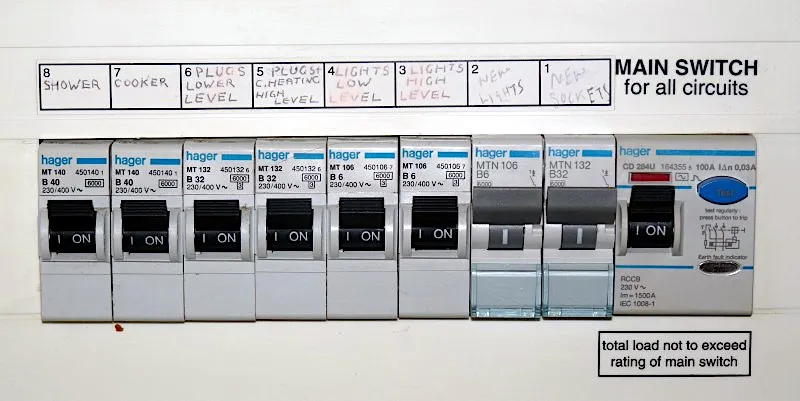
Photo: Pfnicholls, CC BY-SA 4.0, via Wikimedia Commons
There is a particular kind of silence that follows a sudden power cut in a UK home. Then comes the shuffle to the cupboard under the stairs, the phone torch, and the question everyone asks: which one is it? The consumer unit — still called the fuse box by most of us — is often labelled in faded biro, with two switches marked “sockets” and one mysterious “spare”. You do not need to be an electrician to improve that. You just need a quiet hour, a little patience, and a plan that everyone in the house can understand.
Start with the board, not the toolbox
First, a sensible boundary. You can look at your consumer unit, read its labels and switch the ordinary trip switches on and off. You should not remove the cover, poke inside, or treat the board as a DIY project. If you notice a burning smell, buzzing, scorch marks, cracked plastic or a switch that feels loose, stop and call a qualified electrician. That is not a labelling job; it is a safety job.
Most modern consumer units have three kinds of switch. The main switch isolates everything. RCDs — residual current devices — protect groups of circuits and usually have a small test button. MCBs — miniature circuit breakers — are the individual switches for lights, sockets, the boiler, the oven and so on. Older boards may have fuse carriers instead of MCBs, and some may have no RCD protection at all. You do not need to master the theory. You do need to know which is which in your own home.
A room-by-room method that actually works
Pick a daytime hour when the house is calm. Tell everyone what you are doing so nobody is caught mid-zoom call or halfway through a hair wash. If someone relies on powered medical equipment, or you have a fridge or freezer full of food, plan around that. You are not trying to leave circuits off for long — just long enough to see what stops.
Take a photo of the board as it is now. Then start with one switch at a time. Switch it off, and walk the house with a helper if you can. A small lamp plugged into a socket is easier than guessing from the hallway. Note what goes off: the kitchen sockets, the downstairs lights, the boiler, the outside light, the garage. Switch it back on before moving to the next one. Keep a simple note on your phone as you go.
Be prepared for circuits that do not match the rooms neatly. A single socket circuit might cover the kitchen, utility room and conservatory. The lights might be split upstairs and downstairs, but the landing light could be on the downstairs circuit. The boiler may have its own switch, or it may share with something else. That is normal. Your job is to record what happens, not to make the house conform to a tidy diagram.
Make the labels readable, not artistic
Once you know what each switch does, label it clearly. A label printer is ideal, but clear tape and a fine permanent pen will do. Write for the person who is panicking in the dark, not for an electrician who already knows. “Sockets — kitchen, utility, conservatory” is better than “SKT KIT/UTL/CONS”. Add the date you checked it, for example “checked Nov 2026”. If a circuit is genuinely unused, label it “Spare — check before use” rather than leaving a blank.
Do not cover old labels until you are confident. Previous owners sometimes had a reason for their wording, even if it is now wrong. Photograph the old labels first, then replace them. If the board has a mixture of old and new circuits, ask an electrician to clarify anything you cannot safely identify. A clear board is useful; a confidently wrong board is not.
The one-page map everyone can find
Labels on the board are only half the job. The other half is a single sheet of paper that tells everyone where the important things are. Keep it simple: your address, the location of the consumer unit, the position of the main switch, the location of any RCDs, and a plain-English list of what each switch controls. Add the water stopcock, the gas meter, the boiler isolator and your electrician’s number. If you have a smart meter or an outside meter box, note that too.
Put one copy in a kitchen drawer and take a photo for your phone. Tell everyone in the house where it lives. A house sitter, a visiting relative or a teenager home alone should be able to find it without ringing you. This is not about expecting disaster. It is about removing the small moment of panic when a trip switch does what it is designed to do.
When a switch trips, resist the flicking habit
If a circuit trips, do not stand there flipping it back on again and again. Unplug the appliances on that circuit — kettle, toaster, heater, chargers — and reset it once. If it stays on, plug things back in one at a time. If it trips again straight away, leave it off and call an electrician. If an RCD trips, it may have taken several circuits with it, so check the map and note what was running at the time. And if you ever smell burning or see scorch marks, turn off the main switch if it is safe to do so and call for help.
The ten-minute annual habit
A consumer unit map is not a one-off craft project. Circuits change when a kitchen is rewired, a shower is added or an outside socket appears. Once a year — perhaps when you change the smoke alarm batteries or put the winter torches back in the drawer — check that the labels still match. Press the RCD test button if your electrician has shown you how, and note the result. If the board is old, has no RCD protection, or has labels you cannot trust, book a qualified electrician to take a look. That is not an admission of failure. It is the same as getting the boiler serviced: ordinary, sensible home maintenance.
The fuse box will never be the most glamorous part of your home. But a clear label and a one-page map turn it from a cupboard of guesswork into a small piece of household calm. Ten minutes now is a lot easier than ten minutes in the dark.