Don't Tape It Up: A Calm, Sensible Guide to a Tripping RCD
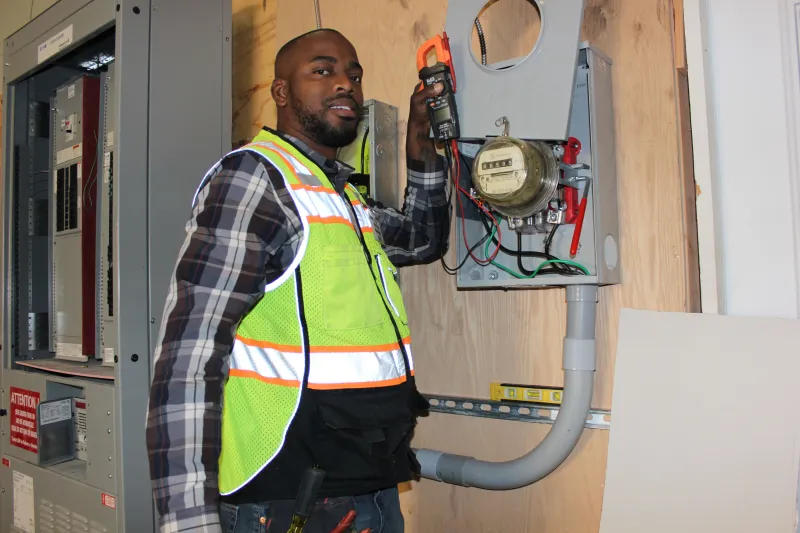
Photo: electrician testing RCD consumer unit UK home close up, via i.pinimg.com
It's half nine on a Tuesday. The heating's on, the dishwasher's running, and then — click. Half the house goes dark, and the only sound is someone in the next room asking what you did. Nothing, probably. Here's what has actually happened, what to do about it in the next ten minutes, and the point at which you should put the screwdriver down and phone somebody.
The switch isn't cross with you
A quick distinction first, because the words get used interchangeably and it muddies everything. An MCB — one of the narrow switches on your consumer unit — trips when a circuit pulls too much current or something short-circuits. An RCD, or an RCBO, which is an MCB and an RCD sharing a single slot, trips when current is escaping to earth. That escape might be as little as 30 milliamps: barely anything, but enough through a person to stop a heart.
So when the RCD drops out, it is almost never the RCD misbehaving. It's something plugged into it, the wiring feeding it, or water sitting where water has no business being. It's a smoke alarm going off — not a smoke alarm breaking. That framing helps, because it tells you the answer lies downstream, in the house, not in the box.
Which is why the worst thing you can do is hold the switch up with your thumb while it fights you, or tape it in the on position. Please don't tape it. That isn't a repair — it's a decision to run a circuit with no safety net, and it's the sort of thing that gets found out at the worst possible moment.
Resetting it properly takes ten minutes
The trick is to do it in an order that tells you something useful.
First, unplug. Not switch off at the wall — physically pull the plugs on the dead circuit. Anything with a heating element or a water supply is the prime suspect: kettle, washing machine, tumble dryer, dishwasher, oven, immersion heater, shower pump. Lamps and chargers can wait.
Second, push the RCD back up. Firmly, all the way, until it clicks. If it stays up with everything unplugged, you've narrowed things down beautifully: the fault is in something you've just removed from the circuit.
Third, reconnect them one at a time, giving each a minute and, where it's safe, actually running it. The one that kills the power again is your culprit. Nine times out of ten it's the appliance that's wet, elderly, or was remarkably cheap in 2011.
If only part of the house went off, note which part. On a split board there are usually two RCDs, one covering each half of the circuits, so a single faulty appliance can black out the kitchen and the upstairs sockets together while the lights carry on. That's normal. It isn't evidence of a bigger problem.
If the RCD won't stay up even with the circuit emptied, or it drops the instant you reset it, stop there. That's wiring or board territory, and it belongs to someone qualified.
The usual suspects, roughly in order
- Outdoor sockets and garden lighting, especially after a wet fortnight. Water creeps behind a faceplate and quietly sits there until the next damp morning.
- Anything with a heating element that's scaled or failing — kettles, immersion heaters, ovens, the heater in a washing machine.
- Extension leads trailing across a damp garage or shed floor.
- Older fridges and freezers, whose defrost heaters and compressors fail in creative ways.
- Fairy lights, at this time of year, coiled round a wet hedge. Test them indoors, dry, before they go up. It costs nothing and saves an evening.
- Rodent damage in a loft or underfloor, which tends to show up as a fault with no obvious appliance behind it at all.
The warning signs that mean stop
Resetting a tripped RCD is ordinary homeowner behaviour. The following are not:
- A burning smell near the consumer unit, or a board that's warm or buzzing.
- Brown or black scorch marks on a switch, a socket, or the board itself.
- The RCD won't reset with every appliance unplugged and every MCB switched off.
- It trips again within seconds, every single time.
- Water actually visible in or around the board or an outdoor socket.
- A fuse box with no RCD protection at all — the old cream Wylex with rewirable fuses, say. Not a fault in itself, but a conversation worth having.
In any of those cases, isolate what you can at the main switch and ring an electrician. Don't open the consumer unit yourself. There can be live parts inside even with the main switch off, and the terminals are tight, sharp and unforgiving.
What it should cost in 2026
A decent electrician's callout tends to run £70–£140, with labour around £45–£85 an hour in most of the country and more in London and the South East. Evening and weekend rates will add a premium — and this is precisely the sort of fault that appears at 8pm on a Sunday.
Replacing a single failed RCBO is usually £40–£80 fitted. A tired outdoor socket, £60–£110. If the diagnosis is that the board is ancient and the sockets have no RCD protection, a consumer unit upgrade comes in around £550–£950; that's notifiable work under Part P in England and Wales, so use someone registered with NICEIC, NAPIT or ELECSA, or SELECT in Scotland.
Be wary of the 'no callout fee' advert that turns into a £600 quote in your hallway. Ask for the hourly rate and the callout charge before they set off, and ask them to explain the fault in a sentence you could repeat to a neighbour.
The bit everyone skips
Twice a year — pick the clock changes, they're memorable — press the little T or test button on the RCD. It should click off immediately. If nothing happens, the device has failed and is protecting nothing, so get it replaced. That's a five-second check worth more than any gadget in the house.
And keep a note of what tripped, when, and what you unplugged. Two lines in a notebook or a note on your phone is plenty. Next time — and with a slowly failing appliance there will be a next time — you'll start somewhere far better than 'no idea, it just went'.
An RCD doing its job is the house looking after you. Listen to it, reset it sensibly, and know when to hand the job over.